1. Middle C is 261.6 Hz. Find the following:
a. the next two C's above this note (one and two octaves above)
b. the C one octave below middle C
c. C#, which is one semi-tone (or piano key or guitar fret) above C
d. D, which is two semi-tones above C
e. The wavelength of middle C, if the speed of sound is 340 m/s
2. Consider an organ pipe 0.7-m long. Find the following:
a. the wavelengths of the first 3 harmonics
b. the frequencies of the first 3 harmonics (speed of sound is 340 m/s)
c. the wave shapes associated with the first 3 harmonics - draw them
d. What would happen if you cap this pipe on one end?
Wednesday, October 30, 2013

Monday, October 28, 2013
HW for Wednesday
We did not chat about the well (or equal) tempered scale on Monday. Be sure to bring information about it.
HW related to today's discussion of organ pipes:
Find out the difference between longitudinal and transverse waves. Which type of sound (in air)?
Play around with the applet from class:
http://www.physics.smu.edu/~olness/www/05fall1320/applet/pipe-waves.html
Note that the mathematics of organ pipes is exactly the same as that of guitar strings. The only difference is that there are anti-nodes on each end of an organ pipe. (On a guitar string, there are nodes on each end, since the string is fixed to the guitar neck at top and bottom).
With that in mind. Find the wavelength and frequencies of the first 3 harmonics in an organ pipe that is 50 cm long. Assume that the speed of sound is 340 m/s.
HW related to today's discussion of organ pipes:
Find out the difference between longitudinal and transverse waves. Which type of sound (in air)?
Play around with the applet from class:
http://www.physics.smu.edu/~olness/www/05fall1320/applet/pipe-waves.html
Note that the mathematics of organ pipes is exactly the same as that of guitar strings. The only difference is that there are anti-nodes on each end of an organ pipe. (On a guitar string, there are nodes on each end, since the string is fixed to the guitar neck at top and bottom).
With that in mind. Find the wavelength and frequencies of the first 3 harmonics in an organ pipe that is 50 cm long. Assume that the speed of sound is 340 m/s.
Friday, October 25, 2013
HW
Find out what you can about the equal-tempered scale (in music). It is sometimes called well-tempered.
Thursday, October 24, 2013
Tuesday, October 22, 2013
just cool.
http://www.slate.com/blogs/bad_astronomy/2013/10/21/three_illusions_that_will_destroy_your_brain.html
Monday, October 21, 2013
practice pre-quiz
To prep for Thursday's quiz:
1. Consider a string, 0.2-m long. The fundamental frequency of this string is 40 Hz.
a. Draw the first 3 harmonics.
b. Calculate the wavelengths, frequencies and speeds of the first 3 harmonics.
2. What is the frequency of an 89.7 MHz radio wave?
3. Pendulum problem. Find the period of a 10-m long pendulum.
4. What is the difference between mechanical and electromagnetic waves. Give examples.
5. Consider concert A, vibrating at 440 Hz. What are the frequencies of: the next 2 octaves above this note, and the octave below it.
1. Consider a string, 0.2-m long. The fundamental frequency of this string is 40 Hz.
a. Draw the first 3 harmonics.
b. Calculate the wavelengths, frequencies and speeds of the first 3 harmonics.
2. What is the frequency of an 89.7 MHz radio wave?
3. Pendulum problem. Find the period of a 10-m long pendulum.
4. What is the difference between mechanical and electromagnetic waves. Give examples.
5. Consider concert A, vibrating at 440 Hz. What are the frequencies of: the next 2 octaves above this note, and the octave below it.
Wednesday, October 9, 2013
Lab Guidelines
Your first formal lab will be due in 3 classes. If you want me to have a quick look at it, show it to me within 2 classes.
The lab writeup should have each of the following items:
Title of Experiment - this is up to you
Your name
Lab partner(s)
Date(s) performed
Purpose - the purpose of the experiment, as it appears to you
Data - in table form, with units. Give table a title as well.
Graph(s), where relevant - for this harmonic lab, graphs are optional. They may make your point(s) stronger.
Answers to lab questions - see lab handout
Sources of error and ways to eliminate/reduce error
General conclusion - Talk about what you learned in the experiment. Analyze data. Give thoughts and reasoning, where appropriate. Talk about applications or places where this new knowledge applies.
It's not that different from the first lab - just a couple of extra things. Make sure it is neat.
The lab writeup should have each of the following items:
Title of Experiment - this is up to you
Your name
Lab partner(s)
Date(s) performed
Purpose - the purpose of the experiment, as it appears to you
Data - in table form, with units. Give table a title as well.
Graph(s), where relevant - for this harmonic lab, graphs are optional. They may make your point(s) stronger.
Answers to lab questions - see lab handout
Sources of error and ways to eliminate/reduce error
General conclusion - Talk about what you learned in the experiment. Analyze data. Give thoughts and reasoning, where appropriate. Talk about applications or places where this new knowledge applies.
It's not that different from the first lab - just a couple of extra things. Make sure it is neat.
Tuesday, October 8, 2013
Waves - part 1
There are 2 primary categories of
waves:
Mechanical – these require a
medium (e.g., sound, guitar strings, water, etc.)
Electromagnetic – these do NOT
require a medium and, in fact, travel fastest where is there is nothing in the
way (a vacuum). All e/m waves travel at the same speed in a vacuum (c, the
speed of light)
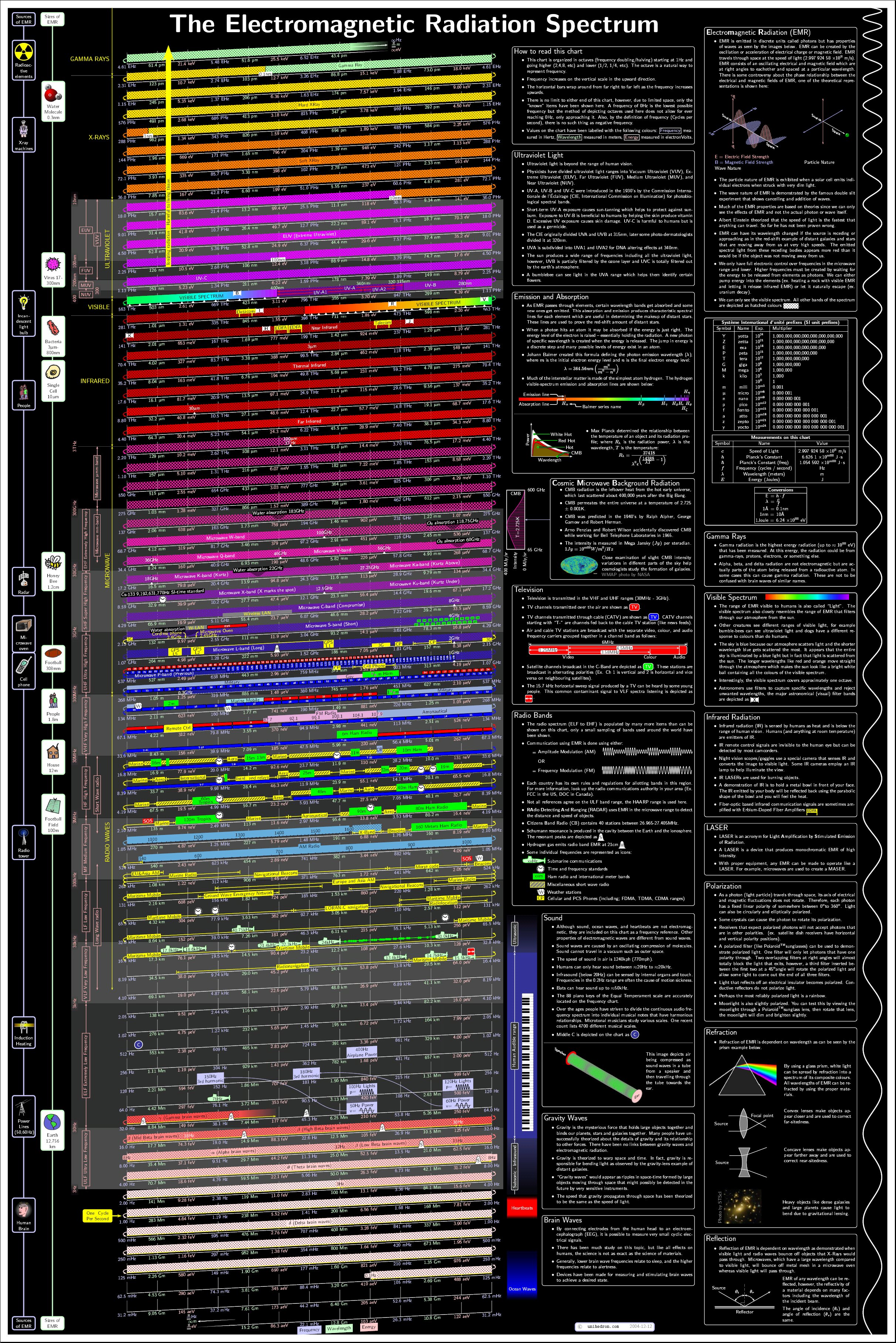
General breakdown of e/m waves
from low frequency (and long wavelength) to high frequency (and short
wavelength):
Radio
Microwave
IR (infrared)
Visible (ROYGBV)
UV (ultraviolet)
X-rays
Gamma rays
In detail, particularly the last
image:
Waves have several characteristics
associated with them, most notably: wavelength, frequency, speed. These
variables are related by the expression:
v = f l
speed = frequency x wavelength
(Note that the 'l' above should be the Greek letter 'lambda'.)
(Note that the 'l' above should be the Greek letter 'lambda'.)
For e/m waves, the speed is the
speed of light, so the expression becomes:
c = f l
Again, the 'l' should be Greek letter 'lambda'.
Note that for a given medium
(constant speed), as the frequency increases, the wavelength decreases.
Note the units:
Frequency is in hertz (Hz), also
known as a cycle per second.
Wavelength is in meters or some
unit of length.
Speed is typically in
meters/second (m/s) or cm/s.
Sound waves
In music, the concept of “octave”
is defined as doubling the frequency. For example, a concert A is defined as
440 Hz. The next A on the piano would have a frequency of 880 Hz. The A after
that? 1760 Hz. The A below concert A? 220 Hz. Finding the other notes that
exist is trickier and we’ll get to that later.
Interference
Interference
Waves can “interfere” with each
other – run into each other. This is true for both mechanical and e/m waves,
but it is easiest to visualize with mechanical waves. When this happens, they
instantaneously “add”, producing a new wave. This new wave may be bigger,
smaller or simply the mathematical sum of the 2 (or more) waves. For example, 2
identical sine waves add to produce a new sine wave that is twice as tall as
one alone (as in, 1 sin x + 2 sin x = 3 sin x). Most cases are more complicated
(1 sin x + 3 cos x = .....).
In music, waves can add nicely to
produce chords, as long as the frequencies are in particular ratios. For
example, a major chord is produced when a note is played simultaneously with 2
other notes of ratios 5/4 and 3/2. (In a C chord, that requires the C, E and G
to be played simultaneously.) Of course, there are many types of chords (major,
minor, 7ths, 6ths,…..) but all have similar rules. In general, musicians don’t
remember the ratios, but remember that a major chord is made from the 1 (DO),
the 3 (MI) and the 5 (SO). It gets complicated pretty quickly.
We looked at specific cases of
waves interfering with each other – the case of “standing waves” or
“harmonics.” Here we see that certain frequencies produce larger amplitudes
than other frequencies. There is a lowest possible frequency (the resonant frequency)
that gives a “half wave” or “single hump”. Every other harmonic has a frequency
that is an integer multiple of the resonant frequency. So, if the lowest
frequency is 25 Hz, the next harmonic will be found at 50 Hz – note that that
is 1 octave higher than 25 Hz. Guitar players find this by hitting the 12th fret
on the neck of the guitar. The next harmonics in this series are at 75 Hz, 100
Hz and so on. Or if you prefer, fn
= n f1.
Friday, October 4, 2013
one more thing
http://phet.colorado.edu/sims/wave-on-a-string/wave-on-a-string_en.html
Play around with this, if you haven't already.
Play around with this, if you haven't already.
Subscribe to:
Posts (Atom)